Showing posts with label Basic 101. Show all posts

Saturday, November 18, 2006

The Free Buddhist Encyclopedia Project


While reading posts on another site, I saw mention of the Buddhist Encyclopedia. I surfed on over and was impressed. They have not been up for very long but have had over 1700 articles submitted. The BEP is in Wikipedia format so anyone with an account is able to submit or edit articles (within reason). After poking around, there is indeed a lot of good information. Why not wander over and check it out? http://buddhism.2be.net/Main_Page

Tuesday, October 03, 2006

The Four Great Bodhisattva Vows


SENTIENT BEINGS WITHOUT NUMBER WE VOW TO ENLIGHTEN

For a Bodhisattva, the eradication of one's own suffering is joined with the desire to aid in the eradication of all others' suffering as well. The real Bodhisattva identifies the immeasurable distress of all sentient beings as his own. With this Immeasurable Compassion (Maha-karuna), one can take the second vow:


VEXATIONS WITHOUT NUMBER WE VOW TO ERADICATE

The desire to win Supreme Bodhi, convert and liberate sentient beings, aid in the eradication of their distress, etc., should not be an impulse based on idle sentimentality or romantic notions of spiritual life. This noble aspiration can only come to completion provided that there is a strong foundation of wisdom. With wisdom only, and not otherwise, can one spread the Dharma and assist living beings. This wisdom arises from a keen desire to learn and practice the Buddha-dharma. Therefore, the Buddha said, "All Buddhas in the three periods arise from learning and practice." One who is not willing to learn will remain eternally foolish, and what foolish man or woman ever completed the Bodhi Tao, spread Dharma and assisted sentient beings? See: THE BUDDHA: Five Qualities of a Dharma Teacher.

As there is immeasurable distress in the lives of sentient beings, there are innumerable methods of Dharma practice. Therefore, the third vow of great compassion is as follows:


LIMITLESS APPROACHES TO THE DHARMA WE VOW TO MASTER

When one perceives the suffering of sentient beings, one vows to Enlighten sentient beings without number when perceiving the distress in one's life and that of others, one vows to eradicate vexations without end. Perceiving the myriad Dharma doors to Enlightenment, one vows to master them all. Perceiving the truth of Nirvana, one vows to attain the Supreme Bodhi.


THE SUPREME ENLIGHTENMENT WE VOW TO ACHIEVE

Enlightenment is Bodhi; Supreme Enlightenment is the Anuttara Samyak Sambodhi or the Buddha Fruit. Determining the Bodhicitta means using the faith of our worldly minds to vow to complete this path. However, if one is to complete this vow, one should have the support of the other three Great Vows. To arrive at Anuttara-Samyak-Sambodhi, one should have the desire to spread the Buddha-dharma and effect the liberation of all sentient beings.

Source http://www.angelfire.com/electronic/awakening101/four-vows.html

Zen Classics - The Diamond Sutra


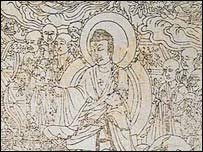
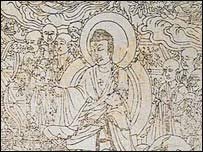
The Diamond Sutra was the second sutra I studied. It in conjunction with the Heart Sutra sums up the essence of Zen Buddhism. This sutra contains the Bodhisattva Vow, the concepts of emptiness as well as directives on mindfulness and constant meditation and practice. Here is part of the introduction from a translation that I really like...... LINK


Introduction

The Diamond Sūtra (Vajracchedika-prajñāpāramitā-sūtraspan>) has maintained a high degree of popularity in the Mahāyāna Buddhist tradition for over a millenium, especially in East Asia, and most importantly within the East Asian meditation (Chan/Seon/Zen/Thien) school, where it has been recited, taught, and commented on extensively up to the present day. One reason for its popularity is its brevity — it can be chanted in about forty minutes, which means that it is something that an average person can memorize without superhuman effort. More important, though, is the basic resonance of the text's message with a core aspect of Chan doctrine/practice — the theme of "non-abiding." Non-abiding, in a Buddhist, and especially a Chan context, refers to the continual practice (i.e., not just while one is sitting in zazen) of being aware of the stoppings and goings of the mind, and avoiding being tricked and ensnared by the web of mental constructs that one continually weaves for oneself. The ongoing proliferation of these deluded constructs has as its causes and conditions not only in the thought processes in which one is engaged at the present moment, but also the flowing river one's entire multi-lifetime load of previous karma. And not only one's own karma, but the linguistic/karmic flow of one's entire culture.

A vitally important message of the Diamond Sūtra is that non-abiding should not be misconstrued as a nihilistic sort of practice. On the other hand, it also does not imply simply giving free reign to one's thoughts, since then, one is certainly going to get further wrapped up in the dense web of one's own spinning. Non-abiding necessitates the kind of moment-to-moment attentiveness that is awesome in its required subtlety. Nonetheless, with just a modicum of experience in meditative practice, the new student of the Diamond Sutra will no doubt begin to get some sort of feel for what is going on in this text. In a sense, it is simple: the thoughts, labels, signs, characteristics, etc., that we associate with given things, are nothing more than labels, and should not be imputed as the reality of the thing in itself, thus becoming reified objects of our desire and dislike. Yet there is also such a thing as thinking and seeing correctly, and it is permissible, nay, necessary, to use these notions, signs, and labels to function in daily life, and especially to study Buddhism for the aim of attaining enlightenment. Thus, Buddhism (and any other responsible contemplative tradition) cannot condone any attitude that recommends negating, or running away from any of the experiences that impinge upon our consciousness. Nor can it maintain that there is any such thing as a fixed, or final truth. As the Daodejingan> says, "The Way that can be taught is not the true Way." Either of these extreme options are none other than another form of abiding, or appropriation.


Source http://www.hm.tyg.jp/~acmuller/bud-canon/diamond_sutra.html
Thursday, September 14, 2006

Buddhism 101 - Part 2

The 8-Fold Path. The path is the extension of Noble Truth number four. This is the checklist that the Buddha gave to us to help us reach nirvana aka the end of suffering. The path is divided up and graphically represented by a wheel.

The three major categories of the path are wisdom, ethical conduct and mental discipline sometimes called meditation. In a broad sense that is accurate, but meditation (the sitting kind) is only a part of the mental discipline category.

From Wikipedia - In all of the elements of the Noble Eightfold Path, the word "right" is a translation of the word samyañc (Sanskrit) or sammā (Pāli), which denotes completion, togetherness, and coherence, and which can also carry the sense of "perfect" or "ideal".

Though the path is numbered one through eight, it is generally not considered to be a series of linear steps through which one must progress; rather, as the Buddhist monk and scholar Walpola Rahula points out, the eight elements of the Noble Eightfold Path "are to be developed more or less simultaneously, as far as possible according to the capacity of each individual. They are all linked together and each helps the cultivation of the others.


* Wisdom (Sanskrit: prajñā, Pāli: paññā)
1. Right understanding
2. Right intention

* Ethical conduct (Sanskrit: śīla, Pāli: sīla)
3. Right speech
4. Right action
5. Right livelihood

* Mental discipline (Sanskrit and Pāli: samādhi)
6. Right effort
7. Right mindfulness
8. Right concentration

As time goes on I will try to address each of the 8 points, but please keep in mind entire books have been written on this topic. Here is a great study LINK for more information.

Buddhism 101 - Part 1


The backbone of all Buddhist teachings is the 4 Noble Truths. The first sermon that the newly enlightened historical Buddha gave was about the 4 Truths. This sermon was given in a deer park and has come to be known as the Samyutta Nikaya.

Therefore, the Buddha said in the Samyutta Nikaya: These Four Noble Truths, monks, are actual, unerring, not otherwise. Therefore, they are called noble truths.

So, what are these truths? Well......

1. Life entails suffering (dissatisfaction) also known as duhkha
2. Dissatisfaction is a result of suffering (craving/desire) also known as trishna
3. Suffering can be stopped also known as nirvana
4. The way to end suffering is with the 8-fold path also known as maggha

Again from the Samyutta Nikaya: Why have I declared (the four noble truths)? Because it is beneficial, it belongs to the fundamentals of the holy life, it leads to disenchantment, to dispassion, to cessation, to peace, to direct knowledge, to enlightenment, to Nirvana. That is why I have declared it.

Here is a great LINK to a study guide. It goes into great detail on something that seems so simple :-)